
When an Easy Run Still Means 1,500 ft Elevation
Yesterday I did something I hadn't done in a few years: I ran 100-meter sprints on the track.
And I loved it.
After an hour of easy Zone 2 running, I finished the session with the short, fast efforts. There's something exhilarating about running at those speeds again. After spending so much of my training focused on endurance and long-distance running, the feeling of turning my legs over quickly was a fantastic reminder that running fast can still be fun.
There was another important development yesterday too.
I returned to strength training.
Strength training is normally a twice-a-week part of my routine, but I'd stopped for about three months. Yesterday was my first weights session back, so combining that with the 100-meter sprints made for quite a bit of stimulus after a long period without either.
I paid for it this morning.
Waking up feeling like I'd been hit by a truck
When I got out of bed today, I was stiff, achy and tired.
In other words, I knew exactly what yesterday's workout had done.
But I still got up, had breakfast and coffee, and headed out to the base of Montego Mountain for my run.
Normally, I like to follow a difficult training day with an easy run. That's still the plan.
But there's a slight complication in my current training.
I'm preparing for a 100-mile race in Chiang Mai, Thailand, and the course has around 30,000 feet of elevation gain.
That means I can't simply make every recovery run flat.
Elevation has to become part of my weekly training volume.
An Easy Run with 1,500 ft Elevation
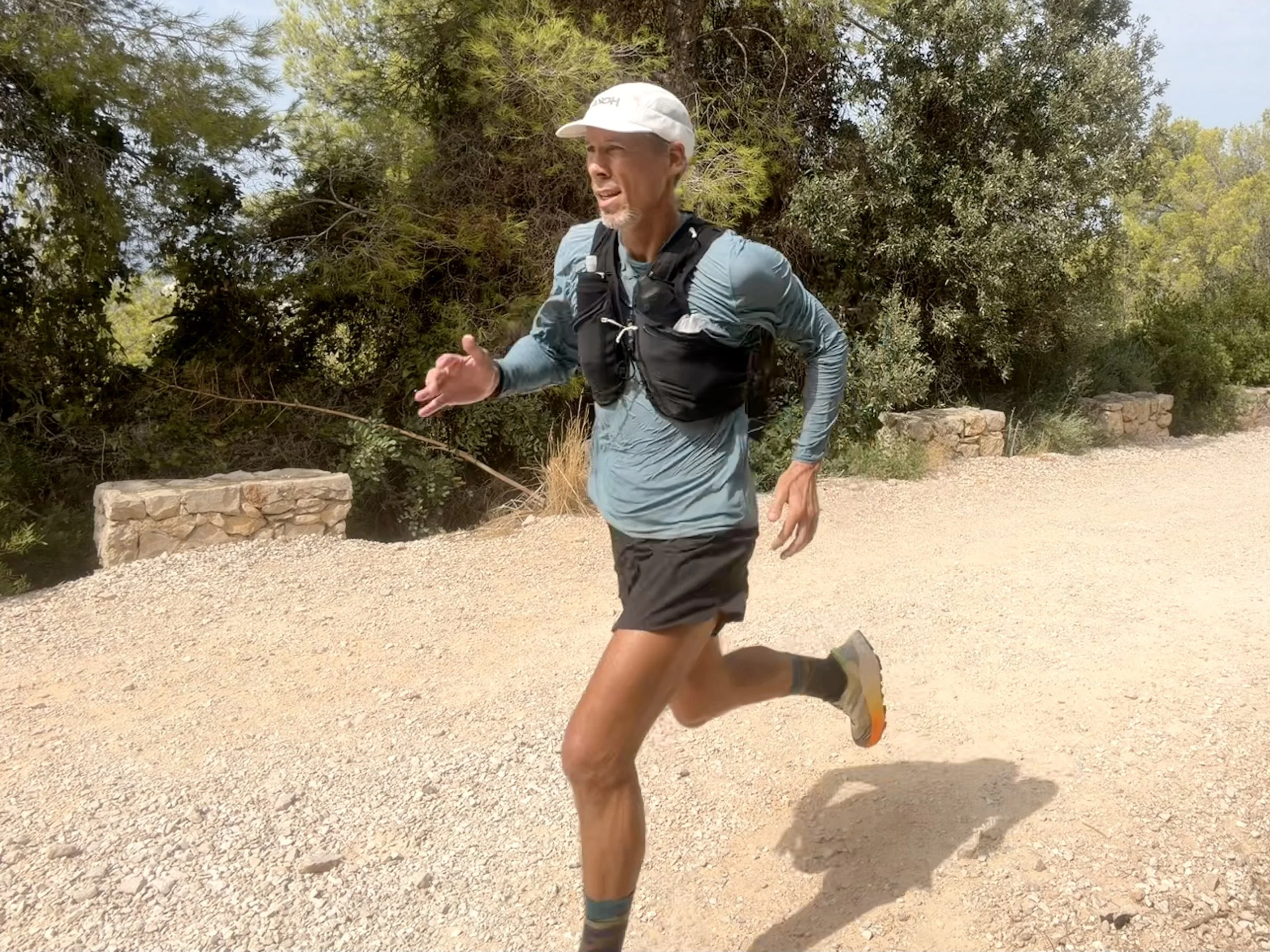
My route today involved repeated climbs and descents of a roughly 500-foot hill, much of it on trail.
The first couple of repeats were not pretty.
I was around a minute per mile slower than I had been on previous training sessions, both on the way up and on the way down. My legs were simply not ready to move at their normal pace.
But I wasn't particularly concerned.
The important thing was that after about 20 minutes, my body started to loosen up.
I was still slower than usual, but the stiffness was beginning to disappear and what I was feeling was predominantly the expected muscle soreness from yesterday's sprinting and strength work.
That's a very different feeling from something being wrong.
There were no sharp pains, no unusual sensations and no signs that suggested I was dealing with an injury.
So I kept going.
That's one of the things I think is important to remember about easy running: easy doesn't necessarily mean fast, flat or effortless.
Sometimes easy means accepting that your pace is slower than normal and allowing your body to absorb the previous day's training.
Training for the elevation, not just the distance
One of the challenges of preparing for a 100-mile mountain race is that running mileage alone doesn't tell the whole story.
The legs need to be prepared for hours of climbing and descending.
With roughly 30,000 feet of elevation gain in the race, I need to make climbing a regular part of my training rather than something I suddenly introduce during a long run.
That's why today's run was useful even though I was considerably slower than normal.
The objective wasn't to set a personal record on the hill.
The objective was to get the elevation into my legs while keeping the effort controlled.
That's a very different training mindset.
Perfect weather—and a simple trick for running in the heat
The weather couldn't have been better.
The sun was out, there wasn't a cloud in the sky, and the temperature was in the mid-80s Fahrenheit.
That's warm enough that staying cool becomes part of the training strategy.
As I passed a water fountain, I stopped briefly and wet the arms of my long-sleeve HOKA T-shirt.
It sounds ridiculously simple, but it works.
Getting the fabric wet gives you some immediate cooling as the water evaporates, and it's a strategy I really like when running in hot conditions.
When you're running in temperatures around 80°F and above, little things like this can make a surprisingly big difference to how comfortable the run feels.
Nearly 100 miles in my HOKA Speedgoat 7s
I'm also approaching another little milestone with my footwear.
I've put almost 100 miles into a pair of HOKA Speedgoat 7s, which I'm currently testing.
So far, they've been getting plenty of opportunity to prove themselves.
Trail, climbing, descending, heat, easy running—the shoes are seeing a reasonable variety of conditions as I build toward the 100-mile race.
I'll continue to report back on how they're performing as the mileage accumulates.
A podcast, then a bike ride home
During the run I listened to an episode of the UltraRunnerPodcast.Com featuring Catra Corbett.
There's something I really enjoy about long-distance training: you can turn a run into an opportunity to learn as well as train.
Once I finished the run, I jumped on my bike and cruised back down the hill.
It wasn't a spectacular training day.
There were no fast times. No heroic mileage. No breakthrough workout.
And that's exactly why I think it was a good one.
Yesterday I gave my body a new stimulus with sprinting and strength training.
Today I gave it an easy run, but I still accumulated some of the climbing I need for the much bigger challenge ahead.
That's what this phase of training is about: building the body I will need for 100 miles and 30,000 feet of climbing.
One day at a time.
Thinking about your own running?
If you're training for a marathon, ultra, trail race or simply want more structure and direction in your running, run coaching can help turn individual workouts into a coherent training plan.
My coaching is designed around the runner, the goal and the demands of the event—not simply a generic schedule.
